




Blog
Why Your eCommerce Business Is Stuck Between £1m and £3m And How to Break Through
Shaun
Creative Director
Introduction
There is a structural trap every £1–3m eCommerce business eventually hits. We can show you how to break free. This is the case for a growth partner
There is often a moment in almost every eCommerce business when the owner realises they are trapped.
Trapped at a revenue ceiling they can’t break through.
Trapped in a ‘job’ they can’t leave without the business collapsing.
Trapped in a circle of fire-fighting and gap filling that means they don’t have time to work out their next move.
The eCommerce Fuel 2026 trends report is specific about when this point is. According to the data, eCommerce businesses in the $1–2.5m revenue tier show a median revenue growth of just 10%; a third of the operators at this level are shrinking, more than half of the founders (53%) take only a modest salary or nothing at all. Only 21.4% extract meaningful funds and those founders are almost entirely concentrated above the £5m threshold.
But this trapped feeling isn’t because of a failing business; sales are steady, customers are returning, the brand is real and the topline is moving in the right direction.
The problem isn’t market conditions, a lack of customers or low product quality, but rather the business structure.
The one that made sense as a start-up, but now isn’t fit for the business they have built.
This is the time to build a new structure. This guide shows you how.
The org chart that made sense is now holding you back
The structure that almost every UK eCommerce business earning less that £5m converges on looks something like this:
– One founder doing strategy, trading decisions, maintaining key supplier relationships, most of the financial thinking and often a chunk of the marketing
– One operations or logistics hire keeping the supply chain and fulfilment moving
– One junior in-house marketer managing the channels the founder no longer has bandwidth for
– A collection of freelancers including a photographer, a copywriter, a Meta specialist brought in when the account stops performing
This structure made perfect sense at £500k. It was a rational response to the constraints of a bootstrapped early-stage brand. At anything above £1.5m, it is the constraint.
The people aren’t wrong, the founder is doing anything wrong, but the business has outgrown its structure. Now is the time to create a structure to match where the business is, or more specifically, where it wants to get to in the future.
The work that needs doing at £1.5–3m is materially different to the work that got the business started. And the gap between that work and what the current team can deliver is where some of the growth inhibitors are.
In-house requirement vs in-house capacity
This is the part most businesses understand but few can act on.
The in-house marketer, often junior, typically costing between £28,000 and £38,000. They are passionate about the brand and genuinely capable, but they are carrying the strategic weight of a role that requires ten or twelve years of experience and a with it a fundamentally different skill set.
They are managing the Meta account without a deep understanding of how the Andromeda architecture has changed creative strategy in 2026. They are sending Klaviyo campaigns without a retention model to optimise against. They are prioritising campaigns without a clear contribution margin per SKU, or are producing content without a creative brief. They are reading the in-platform attribution dashboard without the sophistication to know that it is lying to them.
None of this is their fault. They are doing what they have been asked to do with the skills they have. The problem is the gap between the job title and the actual job requirements.
The senior marketing hire who could actually do this work; someone with genuine performance marketing experience, a track record on the channels that matter for your acquisition model and the ability to own a strategy rather than just execute tasks, costs somewhere between £75,000–£95,000 including the tools they need to do the job.
For a brand earning £2m, running at the eCommerce Fuel 2026 average net margin of 10.6%, it is making roughly £212,000 of operating profit before the founder takes anything. A senior marketing hire at around £85,000 consumes 40% of it. Most founders know this and that is why the hire never gets made.
The structural trap
The trap is created because the founder can’t make the structural changes the business needs, because they’re too busy managing the gaps in the team they have.
Does the following sound familiar?
Reviewing the Meta account rather than working on P&L architecture, briefing freelancers rather than focusing on channel diversification, paying more to acquire new customers because the retention model isn’t in place to generate real customer lifetime value.
The £1-3m revenue band isn’t a phase you pass through, for most brands, it’s where they stay. Not because growth is impossible, but because the structural changes required to break through it are exactly the ones the founder can’t make alone.
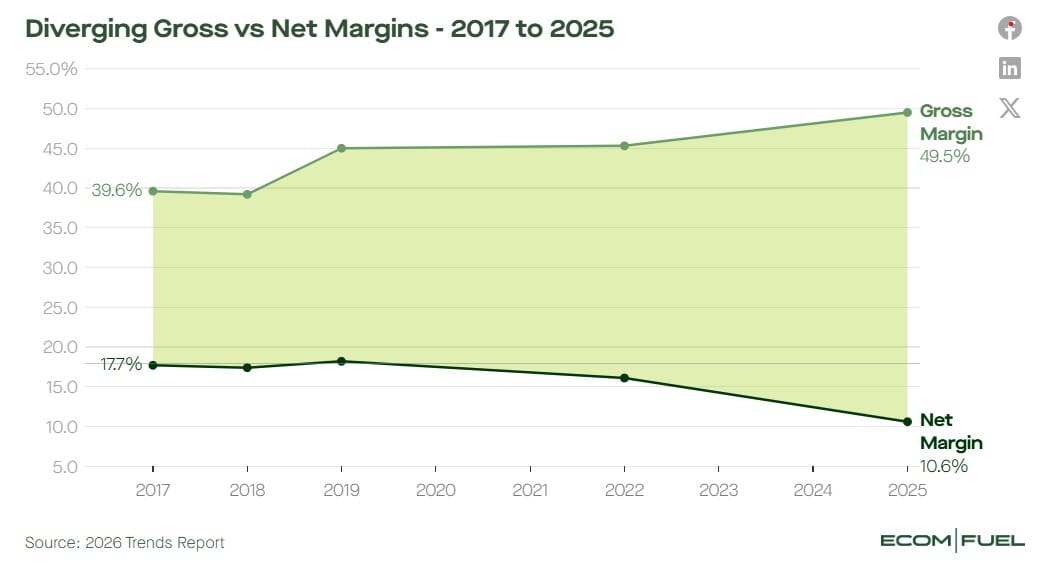
According to eCommerce Fuel data, the ceiling is visible, top line is growing; gross margin for brands at this revenue band is at a record high of 49.5%, but net margin is being squeezed to an average of 10.6% which represents a record low, and the two lines are diverging. The paid ads account isn’t the problem. The channel mix is possibly fragile and maybe over-reliant on one platform but the root cause of the stagnation is overhead cost.
Seeing all of this clearly, and being unable to act on it fast enough, that’s the trap.
The right eCommerce agency support
One response is to brief more freelancers. This isn’t wrong. For specific, well-defined pieces of work, the right specialist is often the most efficient use of the budget available.
The problem is that the work this type of business needs most isn’t specific or well-defined. The strategic layer of P&L thinking, channel architecture, retention model, creative strategy, these require continuity, deep business knowledge, and genuine accountability for outcomes, not just delivery against a brief. Freelancers, by definition, rarely provide that.
This is when it’s important to get the right sort of agency support. A partner eCommerce agency shouldn’t primarily be a channel execution resource. The current team can do that albeit imperfectly. What’s currently missing is the strategic and structural layer that builds consistency and leads to compounding gains.
In practice, that means:
P&L clarity at channel level: A clean model of contribution margin per order, per SKU, per channel, so investment decisions are data-led rather than reactive.
A modelled retention architecture: Not just Klaviyo flows, but a real understanding of what a 5-point improvement in repeat purchase rate does to acquisition economics and exit multiple.
Creative strategy grounded in the business: Not “what content should we make this month”, but which creative ideas, at what AOVs, on which channels, generate the contribution margin the business needs to grow.
Attribution honesty: Moving from platform-reported ROAS to a genuine understanding of which spend drives incremental revenue, and which is taking credit for revenue that would have happened anyway, or worse, cannibalising existing acquisition.
Channel mix independence:Reducing reliance risk is simultaneously the most important exit-prep work and the hardest to justify when the dominant channel is still performing.
While these may not bring quick wins, when done consistently over time, it’s what determines whether the business breaks through the £3m revenue ceiling or stays under it.
Your agency partner should lead this conversation, not a media plan, not a creative deck, not a capabilities presentation, but a focus on your P&L and honesty about what your business actually needs.
The three questions to answer before engaging an eCommerce agency
Before any commercial conversation about growth support, here are three questions you need to consider, because the answers determine what kind of help is actually needed or if agency ‘help’ is even viable.
- If you got 30% more revenue tomorrow, would your P&L look better or worse?
The honest answer for most brands at this level is: worse, probably. The overhead would absorb most of it. If that is your answer, the first conversation is not about growth. It is about structure.
- What is your repeat purchase rate, and what is driving it?
Not an approximation, the actual number, from real data. If you cannot answer this, you do not yet have retention clarity and paid acquisition into a leaky retention model is expensive and margin eroding.
- Can you quote your contribution margin per SKU?
Not gross margin, contribution margin; after fulfilment, platform fees, and returns. This is the number that tells you which products can scale with paid support and which ones cannot.
An agency that does not ask these questions is optimising for its own commercial interests, not yours.
Why choose an eCommerce agency like SOZO
We work with a specific kind of operator, one that is numerate, growth-hungry, somewhere in the £1–3m band, and tired of seeing the same results
We start with a data-led diagnosis to understand your contribution margin per SKU, per channel and generate a real attribution picture for customer acquisition costs. If there are overheads worth challenging we will and the person who runs the diagnostic is the person you work with.
We’ll also tell you if the problem isn’t one we can solve; if the work first needs to focus on the P&L before it happens in paid media. Every engagement has milestone-based accountability, and we’ll tell you what happens if we miss them.
We won’t take you on if you can’t quote your contribution margin from memory. Not because we’re difficult, but without that number, the work becomes guesswork. If ROAS improves but profitability falls, we all lose.
If the ceiling is visible and your current structure can’t break it, that’s the conversation we’re here for.
Book a diagnostic call
No deck. No pitch. An honest 30-minute conversation about your P&L and whether we are the right fit for the next stage of it.

Sign up to our newsletter
Keen to learn more about how to grow online?
Get our latest advice articles, masterclass
videos and webinars.
curious for more?