




Blog
AI Search and Agentic Commerce: Are You Prepared?

Mark P
Head of eCommerce
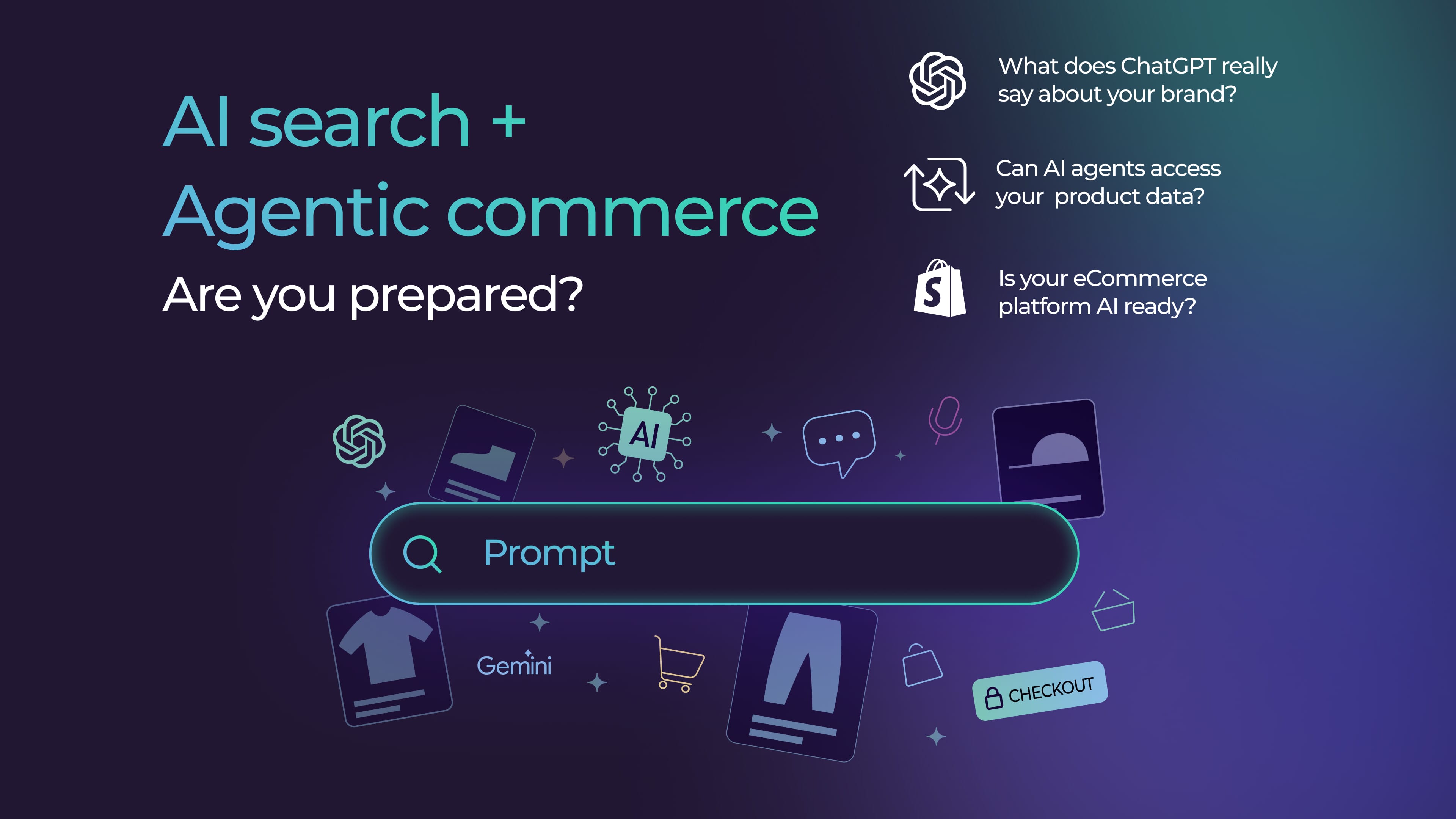
See how AI and the latest trends in eCommerce will shape online retail this year.
Introduction
Agentic commerce is the latest in a long line of examples of how AI is rapidly changing how consumers and brands approach eCommerce.
What began as incremental search and then conversion optimisation, which involved smarter recommendations, dynamic pricing and automated campaigns has accelerated into an AI system that can now research, evaluate and purchase products on a customer’s behalf.
This process is known as “agentic commerce”.
Agentic commerce describes a transactional process where AI systems act autonomously on behalf of consumers to discover products, evaluate options and then complete purchases.
Instead of a human browsing multiple websites, an AI agent can now:
- interpret the user’s intent
- compare products across retailers
- verify availability and pricing
- complete checkout automatically.
Consumers can rely on these AI shopping assistants to cast a wide net to find the best option, compare preferred products and complete transactions automatically, all while in the AI search environment.
The question for eCommerce brands then becomes “how visible is my brand in these AI search results”.
On top of this, advances in generative AI now allows brands to produce high-quality content at scale, while advanced machine learning turns vast sets of first-party data into actionable insights almost instantly.
So really the question isn’t whether this change is coming, it’s whether your eCommerce brand is ready for it.
From SEO to AI search optimisation
For more than two decades, digital growth strategies have relied on traditional SEO. Brands optimised websites with keyword-rich copy, that was derived from human search behaviour on platforms like Google and Bing.
AI-driven search has changed these rules entirely.
Large Language Models (LLMs) and AI shopping assistants don’t “browse” the web like humans. Instead, they interpret, evaluate, and compare structured data.
Instead of serving ten blue links, users often receive one AI-generated recommendation. In many cases, that recommendation may never involve visiting a website at all.
This shift makes optimising your website for AI search critical. If you haven’t yet done it, here are some of the steps you need to take now.
1. Make your catalogue machine-readable
Traditional SEO prioritises keywords and backlinks. AI search prioritises structured, high-quality data.
Every product attribute; from dimensions, materials to sustainability certifications and even delivery options should be encoded in rich metadata and structured schema.
AI agents rely on clean, machine-readable catalogues to assess your products against your competitors.
Without structured data, your products risk being invisible in AI-driven discovery.
2. Optimise for conversational intent
Consumers no longer search for “men’s running shoes”, instead they ask an AI system: “What are the best shoes for a 10K road run, under £100 with good arch support?”
AI can understand context, constraints and intent, so your content must reflect user-case-driven, long-tail information. In AI search, relevance outweighs ranking.
For more insight, see our eBook: 2026 eCommerce Trends: From Clicks to Conversations.
Preparing for zero-click commerce
AI agents no longer just recommend a product or service, now they act. Even before agentic commerce emerged in late 2025, AI systems were comparing products, checking reviews, and confirming delivery timelines based on user prompts.
This functionality has caused a decline in web traffic, with conversions happening without a visit, now, AI agentic commerce agents go even further: completing transactions autonomously in the AI conversion.
Brands must shift from AI visibility to AI operability, ensuring their products aren’t just discoverable, but also actionable by AI systems.
1. Enable open, secure APIs
In the process of discovering and recommending your products, AI agents query structured endpoints to make purchasing decisions. If your data isn’t programmatically accessible, your products may be skipped.
Rather than browsing keyword heavy copy to do this, AI agents increasingly rely on structured APIs or machine-readable data:
- Inventory availability (location, stock levels)
- Accurate pricing, including discounts and bundles
- Shipping options (speed, cost, carbon impact, geographic coverage)
- Returns policies (eligibility windows, fees, friction levels)
Open APIs let third-party AI systems retrieve and act on your data without manual intervention. Brands that can provide live, machine-readable confirmation are more likely to be chosen by AI agents.
Shopify’s Shopify Catalog, a new comprehensive global catalogue of products sold by stores on Shopify, allows AI agents to access product information in real time and integrate with tools like ChatGPT, Microsoft Copilot, and Google AI experiences
2. Establishing trust in agentic commerce payments
Discoverability is only half the equation. For AI-driven commerce to work, there also needs to be a secure, standardised way for transactions to happen.
Alongside Shopify’s global catalogue, which helps make products machine-discoverable, new frameworks are emerging to allow AI agents to purchase safely on a customer’s behalf.
Two key developments are Google’s Agent Payments Protocol (AP2) and the Universal Commerce Protocol (UCP).
Together, they form the infrastructure layer that makes AI-to-merchant transactions possible at scale.
The Universal Commerce Protocol (UCP): a shared language for commerce
UCP allows brands to publish machine-readable product listings so AI systems can understand what a store offers, including product availability, pricing and checkout capabilities, without needing custom integrations for every platform.
For brands, this means:
- Greater discoverability in AI-mediated search
- Reduced dependency on single platforms
- Future-proofed interoperability
Agent Payments Protocol (AP2): the trust layer for AI transactions
AP2 meanwhile creates a secure framework for AI-initiated payments by verifying the user’s instruction, the exact cart contents and the payment itself, ensuring transactions are authorised and auditable.
For merchants, this reduces the risk of fraud, while preserving your role as Merchant of Record. For customers, it builds trust in automated purchasing.
In simple terms, UCP helps AI agents understand what your store can do; checkout, discounts, delivery options or returns and AP2 allows them to complete the purchase securely.
Together, they form the infrastructure that could make AI-driven, zero-click commerce possible at scale.
3. Enhancing your product data for AI discovery
If AI systems are increasingly responsible for recommending products, your product data needs to be understandable not just to search engines, but to machines that can reason.
Traditional ecommerce listings are designed for humans. They typically focus on basic product information such as name, colour, size and price.
But AI agents are often trying to answer broader questions, such as:
“What should I wear for a walking holiday in Scotland?” or “What’s a good, sustainable gift for someone who enjoys cooking?”
To surface your products in these situations, AI LLMs need richer context about what your products are for, and how they might be used, not just what they are.
That means expanding your product data beyond simple catalogue fields to include:
- Use cases (e.g. hiking, commuting, winter travel)
- Customer intent (beginner-friendly, professional grade, gift-ready)
- Environmental conditions (cold weather, rain, indoor use)
- Complementary products (what works well together)
For example, a traditional listing might say:
“Women’s red jacket | Waterproof | Size M”
But AI-readable product data might also indicate that the jacket is:
- Suitable for wet weather walking
- Designed for cool climates
- Often purchased alongside walking boots or base layers
This additional context helps AI systems connect your products to real-world situations and customer needs.
In other words, the brands that structure their product data around intent, use and relationships will be far easier for AI systems to discover, recommend and justify purchasing.
4. Launch owned AI experiences
Agentic Commerce isn’t just about being discoverable on third-party platforms, it’s also about taking control of your own AI touchpoints. Forward-thinking eCommerce brands are deploying their own conversational shopping assistants, chatbots, and AI-driven recommendation engines to create direct, brand-owned interactions with customers.
These owned AI experiences provide several key advantages:
- Capture first-party data
Every interaction with your AI assistant generates valuable insights. From browsing behaviour to product preferences and purchase history, first-party data helps brands understand customers on a deeper level, without relying on external platforms that may limit data access. - Understand customer intent
Modern AI can go beyond keyword matching to interpret the nuances of user queries. By capturing context, sentiment, and specific constraints, your AI assistant can surface exactly what the customer is looking for, whether it’s a product for a particular use case, a preferred sustainability standard, or a bundled offer. - Deliver hyper-personalised recommendations
With rich first-party data and intent understanding, AI can deliver dynamic, context-aware suggestions. These recommendations go beyond “similar products” to reflect the customer’s unique needs, preferences, and even lifecycle stage, improving conversion rates and building long-term loyalty. - Reinforce brand tone and trust
Your AI is an extension of your brand voice. Unlike third-party agents, owned AI ensures consistent messaging, communicates your sustainability commitments, and reflects your values throughout the shopping journey. It also provides transparency and reliability in recommendations, reinforcing trust in automated interactions. - Reduce reliance on external gatekeepers
By establishing your own AI touchpoints, you’re no longer dependent on platforms like Google, Shopify, or other marketplaces to mediate customer interactions. This direct connection allows you to own the customer experience, maintain data privacy standards, and retain full control over branding and personalisation strategies. - Enable seamless omnichannel integration
Your AI assistant can unify experiences across web, mobile, social, and in-store channels. This means recommendations, offers, and interactions are consistent and contextual, creating a frictionless, omnichannel journey that strengthens relationships and increases lifetime customer value.
Your owned AI experiences turn AI from a discovery tool into a strategic growth engine. They allow you to orchestrate personalised, trustworthy, and scalable interactions at every stage of your customer journey.
READ From Click to Conversion How AI Optimises eCommerce Funnels
The bigger picture: personalisation, trust, and scale
AI search and agent-led commerce aren’t just about automation, they reshape how brands are found, trusted, and transacted with. Success now depends on three interconnected pillars:
- Personalisation: Every stage of the buyer cycle, from discovery to post-purchase follow-up
- Trust: Transparent data practices, secure AI transactions, and robust governance frameworks
- Scale: Intelligent systems acting on insights faster than human teams
As AI compresses the competitive landscape, being second or third is no longer enough. Visibility alone is meaningless; brands must be actionable, trusted, and ready to transact.
Preparing your AI-driven storefront
AI-driven recommendations are becoming the new digital storefront. When an AI agent can discover, compare, and purchase products on behalf of customers, your store’s readiness for AI determines whether your brand is chosen or bypassed.
Restructuring your data, re-writing your listings and contextualising your products in preparation for agentic commerce isn’t about giving up control, it’s about:
- Structuring machine-readable data
- Ensuring API readiness
- Supporting interoperable protocols
- Embedding human-led governance and trust
Brands that act now will be recognised and recommended by AI agents, while others risk becoming invisible.
Are you prepared?
To thrive in the era of AI search and Agentic Commerce, brands must:
- Shift from SEO to AI Optimisation (AIO)
- Structure product data for machine readability
- Allow for zero-click, API-driven transactions
- Enhance product data?
- Deploy owned AI touchpoints
- Implement strong governance frameworks
This isn’t about chasing hype. It’s about redesigning your digital foundations for an AI-mediated future.
At SOZO, we see this as the next evolution of digital growth, where sustainability, strategy and intelligent systems intersect.
Understand what a comprehensive AIO audit looks like; why technical SEO carries even more weight in AI-led discovery, and the specific fixes that can move the needle.
Shopify AI Search: Technical Fixes to Boost Visibility
Ready to future-proof your eCommerce strategy? Contact SOZO and start building your AI-ready digital foundation today.

Sign up to our newsletter
Keen to learn more about how to grow online?
Get our latest advice articles, masterclass
videos and webinars.
curious for more?