




Blog
What is entity disambiguation in SEO and why does it matter?

Mark P
Head of eCommerce
Entity disambiguation is key to your thinking about SEO strategy.
We know search has fundamentally changed. There was a time when ranking on Google was largely a numbers game. If you identified the right keywords and used them frequently enough on your website, your chances of ranking were high.
SEO was, in many ways, a tactical exercise in matching search queries with on-page text.
But that game is over.
Today, search engines and increasingly AI-driven platforms don’t just scan for keywords. They interpret meaning. They attempt to understand context and relationships between concepts and infer intent in a way that mirrors human understanding.
This shift has been driven by advances in semantic search, the evolution of Google’s Knowledge Graph, and the rapid rise of large language models (LLMs) such as ChatGPT, Claude and Google’s own Gemini. Together, these technologies have transformed how information is discovered, processed, and delivered.
At the centre of this transformation is a crucial concept: entities.
Search engines no longer see content as a collection of words. They see it as a network of entities; a thing or concept that is singular, unique, well-defined, and distinguishable.
They can be people, places, brands, products, and ideas that are all connected through context. And this is where disambiguation becomes essential.
As the volume of online content continues to grow, ensuring that your content is clearly understood by both search engines and AI is no longer optional. It’s a fundamental requirement for visibility.

What is disambiguation?
Disambiguation, at its simplest, is the process of removing confusion and uncertainty in available data or written content.
It is an important aspect of your on-page marketing strategy; human language is inherently ambiguous, and many words and phrases can have multiple meanings depending on their context.
For example, the word “jaguar” could refer to a South American big cat, a former British car brand, or even an American Football team based in Jacksonville.
Without additional context, it’s impossible to know which meaning is intended.
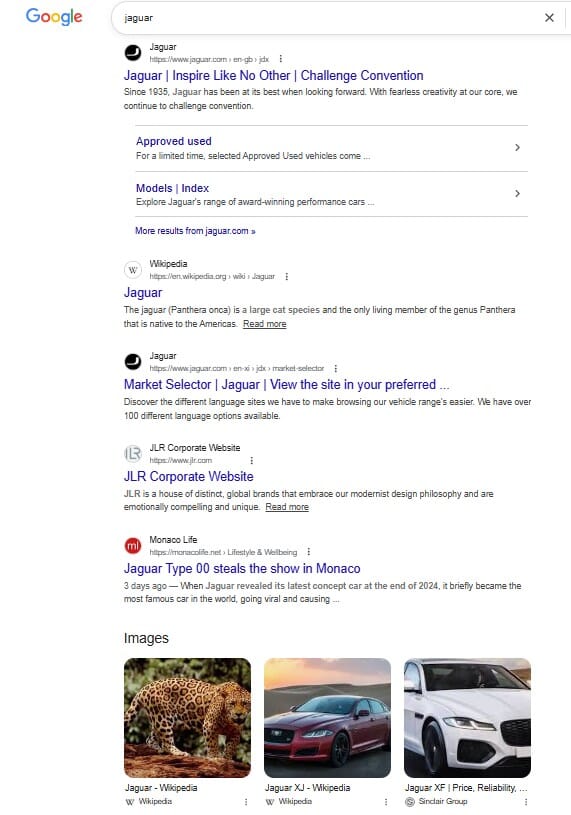
Disambiguation resolves this uncertainty by using surrounding information to determine the correct interpretation.
In the context of search and natural language processing (NLP), this forms part of a broader process known as entity recognition and disambiguation (ERD). This involves:
- Identifying key entities within a piece of content
- Determining exactly which real-world entity each reference relates to
This process is critical for transforming unstructured text into structured, meaningful data that machines, in particular can interpret.
Without disambiguation, search engines can struggle to deliver relevant results. With clarity, they can connect user queries to precise, contextually accurate answers.
If you want help with on page results check out our SEO service: Award-Winning SEO Services UK | SOZO Digital Marketing Agency
Disambiguation in AI search and SEO
In modern SEO, disambiguation refers to the process of ensuring that search engines clearly understand which specific entity your content is about.
This is a significant shift from traditional keyword-based optimisation.
Historically, search engines relied heavily on lexical matching; comparing the words in a query to the words on a page. But modern search systems go much further. They map both queries and content to entities within Google’s knowledge graph, then evaluate how those entities relate to one another.
This means your content isn’t just being matched to a phrase, it’s being interpreted within a wider network of meaning.
When someone initiates a search, Google or ChatGPT isn’t just looking for pages that contain the same words. It’s identifying the entities behind those words, then retrieving content that best matches that meaning and matches it to the intent behind the original search. This is what is known as intent matching, which relies on multiple factors, including your search history and location, to provide the best possible results.
This is a fundamental shift.
Your content is no longer evaluated as a collection of phrases, but as a set of signals that help search engines answer one question: “What is this really about?”
Disambiguation ensures that the answer is clear.
This becomes even more critical in AI-driven search.

Large language models don’t simply retrieve links, they search for products, generate a suggestion and can even complete a transaction based on the intent of the initial prompt. But to do that effectively, they need high-confidence that they have a high degree of understanding of the entities involved.
If your content is vague or inconsistent, these systems may:
- Misinterpret the topic
- Associate it with the wrong entity
- Or ignore it entirely in favour of clearer, more structured sources
But when your content is well-disambiguated, it becomes far more usable. It can be confidently understood, cited, and surfaced in AI-generated answers, summaries, and conversational search experiences.
In this sense, disambiguation isn’t just an SEO tactic; it’s how your content becomes machine-readable in a world increasingly shaped by AI.
Why context and entity clarity are vital
Understanding how search works is one thing. Performing in it is another.
Search engines and, in particular, AI systems don’t reward content they think they understand. They reward content they’re sure about.
That confidence comes from context.
It’s not enough to mention an entity. You need to reinforce it consistently, clearly, and from multiple angles. Every piece of surrounding content acts as a signal, helping search engines validate what your page is about and how it should be classified.
When that context is strong, everything improves:
- Your content is matched to the right queries
- Your chances of appearing in rich results and AI summaries increase
- Your brand is clearly distinguished from similarly named entities
- Your site builds a more coherent, authoritative topical footprint
When it’s weak, the opposite happens. Ambiguity creeps in, relevance drops, and visibility suffers.
This is especially important in a zero-click environment, where users increasingly get answers directly from search results or AI-generated responses. If your content isn’t clearly understood, it won’t be selected as a source.
Clarity also plays a critical role in trust.
Search engines are constantly evaluating signals of Experience, Expertise, Authoritativeness, and Trustworthiness (E-E-A-T). Consistent, well-defined entity relationships reinforce these signals, helping position your content and your brand as a reliable source of truth.
Ultimately, context is what turns information into understanding.
And in modern search, understanding is what drives visibility.
Why human, engaging content still matters
Despite the increasing role of AI in search, one thing remains unchanged: people still want content that feels human.
AI hasn’t changed what we want to consume. They’ve changed what we need to click on.
Well-written, engaging content plays a critical role in disambiguation because it naturally provides the context that machines rely on.
Human writers instinctively:
- Introduce related concepts and supporting ideas
- Use varied, descriptive language
- Build logical connections between topics
- Anticipate and answer user questions
This creates a richer semantic environment, making it easier for search engines to identify and understand entities.
In contrast, content that is overly optimised for keywords or generated without depth often lacks the nuance needed for clear disambiguation. It may mention a term repeatedly without providing enough context to define it properly.
Engaging content doesn’t just communicate information it builds meaning.
And in a search landscape driven by understanding rather than matching, that distinction is critical.
Read our case study on the dangers of letting AI write all of your content
Keywords vs entities: what’s the difference?
To fully understand disambiguation, it’s important to distinguish between keywords and entities as these are two concepts that are often confused.
Keywords
Keywords are the words and phrases people use to search.
They reflect how users express their intent, whether they are looking to learn, compare, buy, or solve a problem.
Examples include:
- “best digital marketing agency”
- “how to improve SEO”
- “website design cost UK”
Keywords are valuable because they reveal demand. They tell you what your audience is searching for and how they phrase their queries.
However, keywords alone don’t define meaning.
Entities
Entities are the things those keywords refer to.
Google defines an entity as something that is singular, unique, well-defined, and distinguishable. This could be:
- A person
- A company
- A product
- A location
- Or even an abstract concept
What makes entities powerful is not just what they are, but how they connect to other entities. These relationships help search engines build a deeper understanding of context.
For example, the entity “Apple” is associated with attributes such as “iPhone,” “MacBook,” and “Tim Cook.” These relationships make it clear that the entity is a technology company, not a fruit.
The Key Difference
The difference can be summarised simply:
- Keywords express intent
- Entities provide meaning
Modern SEO requires both.
Keywords help you align with how users search, while entities ensure that search engines understand what your content is actually about.
Disambiguation is what bridges the gap between the two.
Key techniques for entity disambiguation
To reduce ambiguity and improve how your content is interpreted, you need to take a structured approach. Here are some of the most effective techniques:
To reduce ambiguity and improve how your content is interpreted, you need to take a structured approach. Here are some of the most effective techniques:
1. Entity Linking (sameAs)
Using structured data, you can link entities on your site to authoritative external sources such as Wikipedia, Wikidata, or other trusted databases. This helps search engines confirm exactly which entity you are referencing, increasing confidence in your content.
2. Contextual Content Creation
Context is one of the most powerful disambiguation signals. Surround key terms with relevant, supporting language that reinforces their meaning. For example, mentioning related products, people, or concepts can help clarify the entity being discussed. The goal is to remove any possible confusion through natural, informative writing.
3. Structured Data (Schema Markup)
Schema markup allows you to explicitly define entities within your content. By marking up elements such as organisations, authors, products, and locations, you provide search engines with clear, machine-readable signals about what your page contains. This acts as a foundation for entity recognition and disambiguation.
4. Internal Linking
Internal links help establish relationships between entities across your website. By connecting related pages using descriptive anchor text, you create a network of content that reinforces meaning and builds your own internal knowledge graph. This not only improves SEO performance but also enhances user navigation.
5. Knowledge Graph Alignment
Where possible, align your content with recognised entities in existing knowledge graphs. Consistent naming, branding, and referencing help ensure that all mentions of your entity point to the same identity, strengthening your authority and visibility.
6. Topic Clusters
Organising your content into topic clusters is a powerful way to reinforce entity relationships. A central pillar page supported by detailed subtopics creates a dense network of interconnected content. This helps search engines understand the breadth and depth of your expertise while reducing ambiguity.
Final Thoughts
Disambiguation is no longer a niche concept within SEO, it’s central to how modern search works.
As search engines continue to evolve, and AI-driven platforms become the primary way users discover information, clarity in your content and listings will become even more important.
The shift from keywords to entities represents a broader move towards autonomous agent understanding and disambiguation is what makes that understanding possible.
If you want your content to perform, the focus should be clear:
- Define your entities
- Provide strong, consistent context
- Create content that connects ideas meaningfully for your audience
Because in a world where machines are interpreting information on our behalf, the content that succeeds will always be the content that is easiest to understand.
If you would like to add some clarity and consistency to your content and messaging get in touch today.

Sign up to our newsletter
Keen to learn more about how to grow online?
Get our latest advice articles, masterclass
videos and webinars.
curious for more?