


Blog
Shopify SEO and Paid Media Best Practices for 2026: Driving Traffic to Your Online Store

Mark P
Head of eCommerce
Introduction
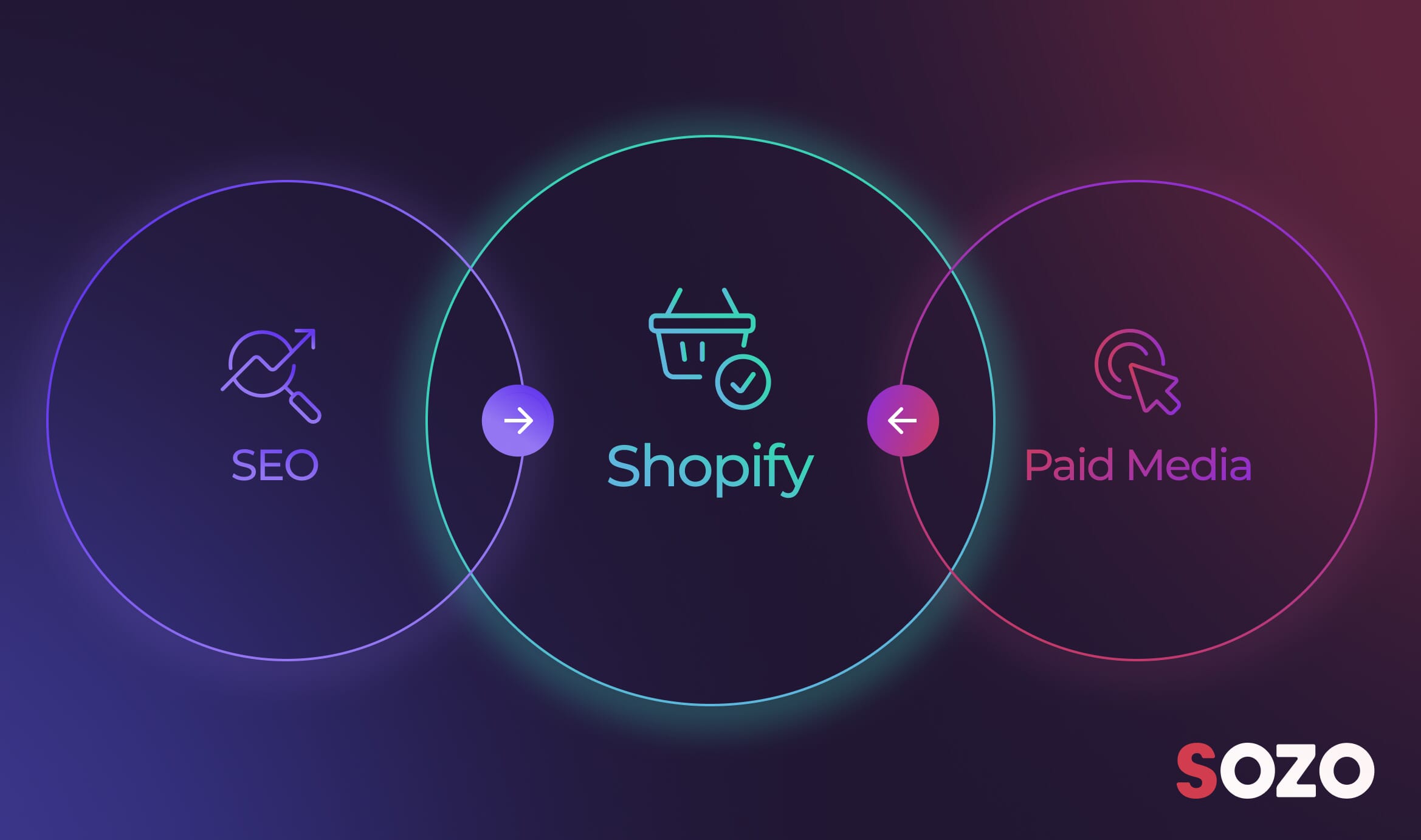
SEO best practice for Shopify stores in 2026 is no longer about isolated tactics. As competition from new eCommerce stores increases and paid media costs continue to rise, the most successful eCommerce brands are those that treat SEO, paid media and conversion strategy as a single growth engine .
Search visibility today is shaped by technical performance, content quality, AI-driven discovery, while consideration and conversion depend on how well organic and paid channels support each other.
This article explores Shopify SEO best practices, while showing how Google and Meta Ads amplify on-line performance by driving more qualified traffic, reducing cost and improving efficiencies to increase conversion opportunities.
Want to understand the trends shaping the eCommerce landscape- download our free eBook.
The role of Shopify in eCommerce growth
Figures released by Shopify at the end of 2025 demonstrated the impact this purpose-built D2C platform has had on eCommerce revenue globally.
The data showed that brands using Shopify generated a record $14.6 billion in sales over Black Friday/ Cyber Monday (BFCM) weekend 2025, up 27% from 2024.
This revenue was generated by more than 81 million customers worldwide that bought from eCommerce brands powered by Shopify.
While Shopify is purpose-built for D2C brands, combining flexibility and scalability that other eCommerce platforms can’t match at SME level, the fact remains that reduced barriers to entry creates increased competition, both domestically and internationally, meaning that even if eCommerce brands chose this platform from the beginning, or re-platform to it later, they still have to work harder than ever to be found, chosen and endorsed by customers.
Role of Shopify SEO and paid media
Despite growth in social selling and alternative channels to market, Shopify SEO remains one of the most cost-effective ways to drive long-term, high-intent traffic to your online store in 2026.
Organic visibility compounds over time, supporting every stage of the customer journey, from discovery to purchase.
Both Google and AI driven search engines now reward sites that combine technical stability, fast performance, clear site structure and genuinely useful content. This means optimising not just for rankings, but for citations, user experience and intent alignment too.
But, while Shopify SEO continues to deliver over the long-term, paid media remains one of the fastest ways to generate demand and revenue in eCommerce.
Unlike SEO, to an extent paid media offers precision and immediacy. Campaigns can be launched, paused or refined in real time, allowing eCommerce teams to react to performance data and market conditions without delay.
For merchants using Shopify, this means the more successful strategies approach these channels holistically.
In 2026, success on Shopify is measured by how well organic traffic converts, not just how much of it you attract. Here’s how to combine a successful organic and paid strategy.
On-page Shopify SEO that aligns with buyer intent
Strong on-page SEO remains fundamental, but it must evolve beyond keyword placement. Modern Shopify SEO tips focus on aligning content with how users search and buy.
Optimising product and collection pages for organic visibility
Product and collection pages are the commercial core of any Shopify store. Optimising these pages involves:
- Clear, intent-led product titles and descriptions
- Collection pages built around category-level search demand
- Internal linking that reinforces topical relevance
- Metadata that encourages click-through from competitive SERPs
Well-optimised collection pages often outperform blog content for revenue-driving keywords, making them central to any eCommerce SEO strategy.
Content that supports discovery and conversion
SEO content for Shopify in 2026 must balance scale with quality. AI-assisted workflows can help brands produce product content including listings, imagery and videos efficiently, but success comes from human-led strategy and editorial control.
Search engines increasingly favour content that demonstrates expertise, usefulness and relevance. When SEO content is built to support product discovery as well as buying decisions and post-purchase engagement, it becomes a powerful commercial asset rather than a traffic-only tool.
Read How to Optimise your Shopify site for AI
Technical Shopify optimisation as a growth lever
Technical SEO is one of the most overlooked areas of Shopify optimisation, yet it often delivers the biggest performance gains.
Site speed, core web vitals and theme performance
Fast-loading Shopify stores consistently outperform slower competitors in both organic rankings and conversion rate. Optimising Core Web Vitals, reducing app bloat and investing in well-built custom themes improves:
- Crawl efficiency
- User engagement
- Conversion performance
Search engines increasingly treat performance as a quality signal, making technical optimisation a non-negotiable for growth-focused eCommerce brands.
Read how to optimise your site’s Core Web Vitals for better SEO performance
Shopify migration without losing organic traffic
If you are using an alternative platform, now may be the time to consider moving. The figures alone demonstrate why Shopify is such a popular choice for brands selling direct to consumers.
It was built from the ground up for B2C brands. Its user-friendly interface, and feature-rich ecosystem is tailored for eCommerce businesses that want to sell directly to consumers, offering everything they need to launch, grow, and scale off the shelf.
Versus other, more enterprise-level platforms, like Magento, Shopify’s accessibility and flexibility make it ideal for eCommerce businesses that are looking to expand their online presence
Whether you are re-platforming or redesigning, Shopify migration requires careful SEO planning. Poorly handled migrations can undo years of organic growth. A structured approach, that includes preserving URLs, managing redirects and maintaining content relevance, ensures visibility is protected and often improved post-launch.
Read our guide to migrating to Shopify: Migrating from Magento to Shopify: The Definitive Guide
The role of paid media in scaling eCommerce growth
While Shopify SEO delivers long-term, compounding value, paid media remains one of the fastest ways eCommerce brands can target customers, generate demand and realise revenue objectives.
Google advertising in the form of Google Shopping and Performance Max campaigns, for example, allow Shopify stores to showcase products across multiple Google channels; from Search and Shopping to YouTube and Gmail, using AI-driven targeting that identifies high-intent audiences in real time.
Along with Meta ads, this allows brands to place products directly in front of the right audiences, who are ready to buy, control visibility during key trading periods and support scale performance at speed.
For many Shopify stores, paid media plays a critical role in:
- Launching new products or collections
- Capturing bottom-funnel, purchase-ready users
- Driving immediate traffic during peak sales windows
- Testing messaging, offers and keywords quickly
Even as standalone channels, paid media drives measurable revenue and accelerates growth in ways SEO cannot match in the short term.
See our Paid Media services Bespoke PPC & Advertising Services UK | SOZO Marketing
Paid media as a performance channel for Shopify stores
When managed effectively, paid media can perform strongly as a standalone channel. Smart keyword targeting, compelling creative and conversion-led landing pages enable Shopify stores to scale revenue quickly, particularly for competitive commercial terms that are difficult to rank for organically in the short term.
However, PPC efficiency is increasingly influenced by factors outside the ad platforms themselves.
Rising competition, higher CPCs and stricter platform algorithms mean that the quality of the website experience, including load speed, message alignment and usability also has a direct impact on campaign performance.
This is where the line between paid media and Shopify SEO begins to blur.
From channel performance to channel synergy
As eCommerce brands mature, the question shifts from “Which channel performs better?” to “How do these channels support each other?”
SEO strengthens the foundations that PPC relies on. SEO is focused on optimising landing pages, refining messaging and ensuring ease of check out, while paid media accelerates visibility, insight and demand from both new and returning customers that SEO alone cannot achieve at speed.
With this in mind, the most effective Shopify growth strategies in 2026 should be built not around individual channels, but around how SEO and paid media work together to drive more traffic, more efficiently, and with greater conversion potential.
Why paid media and Shopify SEO perform better together
As the buyer journey becomes more complicated, the most effective eCommerce strategies in 2026 will be from brands that recognise that SEO and paid media are complementary; they complete, not compete in the buyer journey.
Strong SEO lowers paid media costs
Well-optimised Shopify SEO directly impacts paid performance. High-quality landing pages, relevant content and fast-loading experiences improve Quality Scores, reducing cost-per-click and increasing impression share.
In simple terms: the better your SEO, the more efficiently your paid budget works.
Paid media accelerates organic growth
Paid media plays a critical role in strengthening organic performance. Strategic Google and Meta Ads campaigns:
- Increase brand awareness and branded search demand
- Drive early engagement with new products or categories
- Provide fast data on keyword and audience performance
This increased visibility often leads to a measurable uplift in organic traffic, as users return through non-paid search journeys.
SEO captures broad, mid-funnel and informational demand, building long-term organic visibility, while paid media isolates high-conversion, bottom-funnel intent, accelerating revenue and testing hypotheses quickly.
When combined:
- SEO strengthens landing page relevance, site quality, and product visibility
- Paid media drives faster awareness, engagement, and short-term conversions
- Data from both channels informs optimisation decisions, increasing efficiency and ROI
This unified approach maximises not just reach and discoverability from the right audience, but also improves every visit to your Shopify store, regardless of how users arrive, creating a far more efficient, self-sustaining growth loop.
Building a full-funnel Shopify growth strategy
Neither likes, follows or traffic alone guarantees sales. Integrated strategies ensure that users encounter consistent messaging, fast-loading pages and relevant content at every stage of their journey.
By aligning Shopify SEO, paid media, and CRO, eCommerce brands improve not only visibility of their products but the likelihood of conversion once users arrive on site.
This full-funnel approach is the backbone of 2026 eCommerce growth.
How SOZO delivers sustainable Shopify growth
At SOZO, SEO and paid media are not siloed disciplines. Our integrated teams work together to secure as much digital real estate as possible for your brand.
SEO, along with our new AI Search Optimisation service provides broad-spectrum visibility in Google and LLMs while also capturing intent, while paid media isolates high-value conversion opportunities.
Together, they create scalable, efficient growth strategies designed for modern eCommerce brands.
If you’re investing in Shopify optimisation, planning a Shopify migration, or looking to align SEO, AI Search and paid media into a single performance strategy, get in touch, we help turn prospects into traffic and traffic into measurable revenue growth.

Sign up to our newsletter
Keen to learn more about how to grow online?
Get our latest advice articles, masterclass
videos and webinars.
curious for more?