




Blog
How Sustainable Web Design can Reduce Your Digital Carbon Footprint

Shaun
Creative Director
Introduction
In this blog, SOZO founder Shaun, demonstrates practical steps businesses can undertake to create a more sustainable web.
Most people don’t think of the internet as polluting. It feels invisible, clean, frictionless, weightless. Yet every website visit, every email, every AI query, every file stored in the cloud has a carbon cost. And collectively, those invisible emissions add up to something significant.
In fact, the internet now produces more global carbon emissions than the entire aviation industry, and more than double when you include the explosive rise of AI.
For something we rarely see, its environmental impact is huge.
At SOZO, we’ve spent 25 years designing and building websites, and we’ve watched digital carbon footprints grow rapidly over the last decade. Higher-speed internet, larger images, video-heavy websites, and energy-intensive AI models all contribute to this rise.
As digital tech becomes more intertwined with our lives, the carbon output will only increase, but the good news is this:
There are simple, effective steps every organisation can take to dramatically reduce the impact of its digital footprint, without compromising online performance or creativity.
At a time when on-line eCommerce activity has reached record levels, this article from a webinar for a group of local B CORP businesses explores what really drives digital emissions, how you can reduce your website’s carbon footprint and how innovations like green hosting and our own Eco Mode for websites can make your digital presence significantly more sustainable.
Watch the full video of Shaun’s comments on the B CORP webinar here
Understanding digital carbon: where your website emissions come from
Before you can reduce your digital footprint, it helps to understand where it comes from.
Every website is stored on a server, a physical computer inside a data centre. When someone loads your site, scrolls a page or submits a form, data is transferred from that server to the user’s browser and then to their device.
That data transfer is what consumes energy and generates carbon emissions.
The heavier your website (think large images, autoplaying video, unoptimised code, unnecessary scripts), every single time someone visits a page, the more energy is used. Multiply that by tens of thousands or even millions of page views and the carbon footprint becomes substantial.
Let’s put the numbers into context:
- The average webpage produces 2g of CO₂ per page view.
- A “low traffic” website with around 100,000 page views a year emits over 2 tonnes of CO₂ annually, which is roughly equivalent to driving a petrol car 5,000 miles.
- An eCommerce store with high traffic, high-resolution product imagery and numerous videos can generate many times more.
Now consider that every email you send also has a carbon cost, estimated at around 4g for a simple text email, and up to 40g for emails with large attachments. Even your inbox clutter contributes to energy use, because data storage requires physical servers and cooling.
Digital carbon is real, and it’s growing. But there are ways to counter this explosion.
Sustainability isn’t just good for the environment, it is good for business too. Read our Sustainability Sells eBook to see how a greener approach adds value
Understanding your website’s environmental impact
You can’t improve what you don’t measure.
Start by testing your website using free tools like:
- WebsiteCarbon.com: quick scoring (A, B, C etc.) and simple tips
- DigitalCarbon.online: highly detailed analysis including which specific pages or elements are the biggest offenders
- BioScore.com: advanced environmental scoring (paid)
These tools reveal the hidden impact of design decisions, image sizes, hosting setup and more.
Once you have a baseline, you can make informed, measurable improvements.
1. Choose green hosting: one of the biggest quick wins
Where your website lives matters.
Some hosting providers operate in energy-efficient data centres powered by renewable energy, while others rely on a traditional fossil fuel-led infrastructure.
At SOZO, our hosting platform is powered by 100% renewable energy, which drastically reduces operational emissions. But it’s not just the server’s energy source, a site’s efficiency also matters.
Green Hosting Includes:
- Data centres powered by renewables
- Energy-efficient server hardware
- Intelligent server caching to reduce load
- Global CDNs (Content Delivery Networks) to deliver media from servers closest to the user
- Reduced reliance on energy-intensive legacy infrastructure
Switching to greener hosting could halve your website’s carbon footprint instantly before you redesign or optimise a single image.
It’s one of the easiest, highest-impact changes you can make.
2. Sustainable web design: build lighter, load faster
Most of a website’s carbon footprint comes from its media, especially large images and video. The energy is consumed mainly in the data transfer from server to browser to user’s machine, along with powering the screens of your computers or devices.
Optimise Images
A single oversized hero image can outweigh the rest of your page combined. Modern smartphones take images at extremely high resolutions, far beyond what a website needs.
Our rule of thumb: only upload the resolution your website will actually use.
Here’s a real example from a client project:
- Their logo was uploaded at 3000px wide (1MB file size)
- The displayed size on the site was just 1000px
- We resized it, changed the file from PNG to SVG and compressed the file
- The result was a 93% reduction in file size. (from 1MB down to 77KB)
Multiply that across hundreds of images, and the carbon (and speed) savings are enormous.
Choose the right file formats
- JPG = OK
- WEBP = better
- SVG = ideal for logos and illustrations
- AV1 = new lightweight video codec outperforming MP4 and MOV
Avoid unnecessary imagery
Design has evolved. You don’t need an image on every block. Thoughtful typography, colour, whitespace and illustration can often communicate more effectively and at a fraction of the energy cost.
Use illustrations where appropriate
Illustrations are dramatically smaller in file size and can be more brand-distinctive.
Don’t autoplay video
Only load when the user chooses to engage.
Host video on platforms like YouTube/Vimeo, not directly on your website.
Intelligent loading (lazy loading)
Load images and scripts only when they appear in view.
This reduces upfront data transfer and improves performance.
Reduce third-party scripts
Analytics tools, tracking pixels, embedded widgets and chatbots all add weight.
If it’s not essential, remove it.
Use dark-mode
Dark-mode or darker backgrounds mean the screens use less power to display your website.
3. SOZO’s Award-winning Eco-Mode
When redesigning our own website, we wanted to walk the walk, not just talk the talk. We wanted to create the lowest-carbon site we’ve ever built, while ensuring it still looked beautiful, felt like a premium product and performed faster than the current model. It is our shop window after all.
This is where Eco Mode was born.
Our Eco Mode feature allows users to switch to a low-carbon version of the site at any time. Once activated, it:
- Converts gradients to flat colours
- Switches to dark mode (lower energy usage on many devices)
- Converts colour imagery to black and white
- Reduces and simplifies animated elements
- Optimises image delivery even further
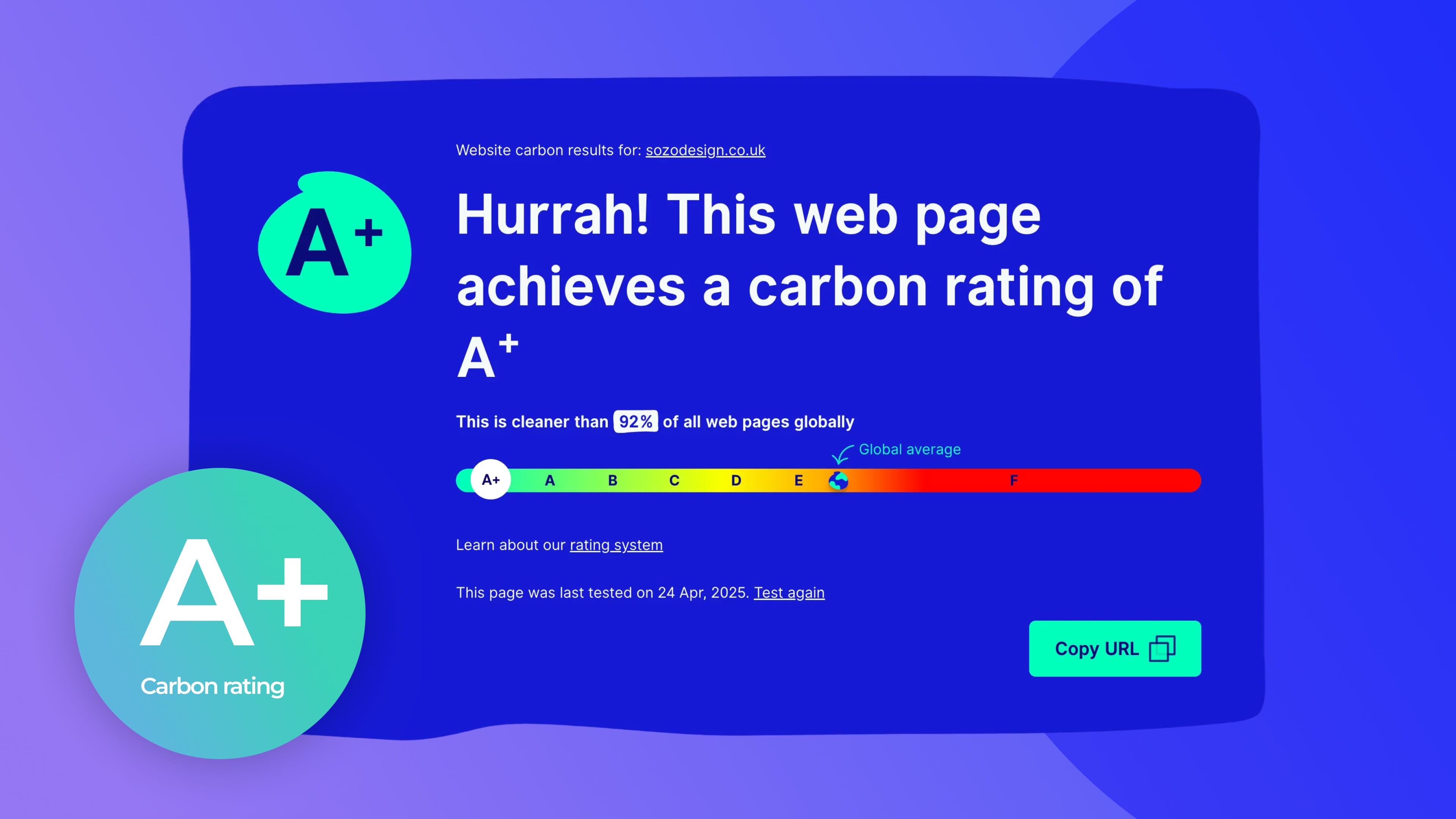
This feature helped our site achieve an A+ carbon rating and recently won an international award for Sustainable Web Design.
Eco Mode proves that sustainability and aesthetics aren’t mutually exclusive, you can have both.
4. Reduce email emissions with good digital habits
Email is often overlooked, but it has a measurable carbon cost.
Latest estimates suggest a carbon weight of around 4g per plain text email, which can be up to 40g plus, depending on the size of any attachments
Over a year, unnecessary CCs and large attachments can therefore create a surprisingly large carbon footprint.
Simple steps to reduce email emissions:
- Think before you CC
- Delete old emails and files
- Unsubscribe from irrelevant newsletters
- Remove email signatures on internal messages
- Use shared links instead of sending attachments
- Have an annual “digital declutter day” (we do this at SOZO)
Small habits, multiplied across a team, make a real difference.
5. AI: a growing carbon challenge
AI is powerful, but energy-intensive.
Recently Sundar Pichai, CEO of YouTube and Google’s parent company Alphabet, highlighted the firm’s investment in AI, However, he also warned about the “immense” energy needs of this new technology, which made up 1.5% of the world’s electricity consumption last year, according to the International Energy Agency.
Training and running large language models requires huge data centres and enormous volumes of water for cooling. AI today is not green, and usage is scaling exponentially.
But there is hope for the future as renewable energy technology advances. It’s now realistic to imagine a future with abundant green energy powering our AI data centres. AI could expedite our research into green energy technology and help with things like carbon capture (although this is a complex and often controversial topic).
Ai could bring unintended benefits too, for example:
AI can reduce carbon in creative workflows
We recently produced an eCommerce website where AI generated all the product photography, avoiding:
- multiple photoshoots
- Travel to and from premises
- lighting/water use
- photography infrastructure
AI also speeds up development and content creation, meaning tasks that took hours can now take minutes, reducing the energy used across the workflow.
And the big players are investing heavily in renewables
Microsoft and Google both claim pathways to net-zero and even net-negative operations. These targets have slipped, largely due to the resulting carbon production of data centres. But while this is growing exponentially and sadly unavoidable, the energy powering them can be renewable.
The key is to use AI mindfully, not excessively.
6. The business benefits: sustainability and performance
Every change that reduces carbon can also improve user experience and with it commercial results.
A low-carbon website is:
Faster: which improves SEO, increases conversion rates, and reduces bounce rates.
More accessible: lightweight pages load well even on slow connections.
Cheaper to run: efficient infrastructure and hosting reduce operational costs.
Higher performing across all devices: low-carbon, allows for high-speed loading and a better UX.
Sustainable web design isn’t just good for the planet, it’s good for business too.
Conclusion: a cleaner, faster, more sustainable web is within reach
Reducing your digital carbon footprint doesn’t require a full rebuild or radical redesign. Most improvements are simple, measurable, and commercially beneficial.
Start with:
- Green hosting
- Image optimisation
- Sustainable design choices
- Fewer scripts and lighter code
- Better email habits
- Conscious AI usage
- Tools like Eco Mode to empower your users
At SOZO, we believe sustainability and performance should go hand in hand and tech and creativity, when used for good, can be part of the climate solution, not just the problem.
If you’d like support redesigning your website for a more sustainable approach, we’d love to help.
Book a free consultation and take the first step toward a greener digital future.

Sign up to our newsletter
Keen to learn more about how to grow online?
Get our latest advice articles, masterclass
videos and webinars.
curious for more?