




Blog
Conversion rate optimisation as an operating system

Mark P
Head of eCommerce
Introduction
Conversion rate optimisation (CRO) shouldn’t be treated in isolation, to see real improvements in their campaign results, successful DTC Shopify brands should build their efforts into a culture of continuous testing, evaluation and application.
Most Shopify merchants know conversion rate matters. The question isn’t whether to improve it – it’s whether you’re approaching it in a way that delivers that improvement and can scale.
The typical pattern looks like this: run a few tests, tweak a CTA, add a pop-up; see a small uplift, move on. Repeat when someone asks about conversion again next quarter. It’s not wrong, but it’s sporadic, and sporadic CRO has a ceiling.
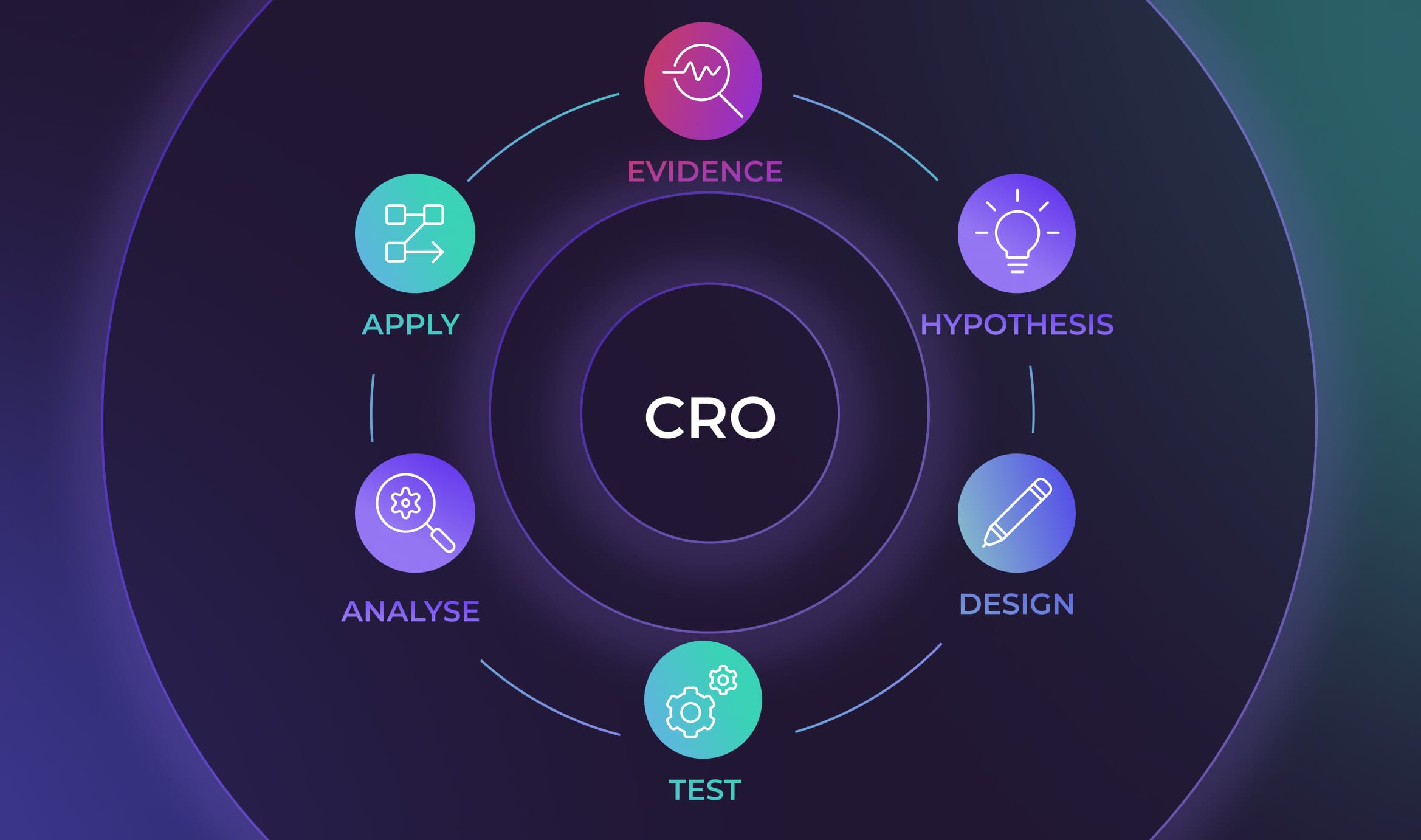
The brands who compound their growth treat CRO differently. Rather than a periodic project, it becomes structural to how the business runs; creating a continuous loop of evidence gathering, hypothesis forming, designing, testing, analysing and applying. Every category, product page, checkout flow and marketing touchpoint is viewed through a lens of optimisation, all the time.
It’s these touch points that make up a conversion rate figure and they each have different metrics that can be improved depending on where the customer is in their purchase journey.
The cumulative result is a higher conversion rate, which usually means greater revenue from the same ad spend or organic website traffic, lowering your cost per acquisition and improving your overall marketing efficiency.
That’s what we mean when we talk about Conversion rate optimisation as an operating system.
Why CRO should evolve from isolated, sporadic tasks to company culture
Traditional eCommerce CRO often feels like a tick-box groundhog day experience. Each isolated push requires context-setting, costs time and the learning rarely carries forward, meaning you end up solving the same problems repeatedly without building any institutional knowledge.
The most effective Direct to Consumer (DTC) brands view CRO as a continuous growth loop; a cycle of evidence gathering, hypothesis forming and testing, analysing, learning and applying to the next test. This shifts the conversation away from “what should we test next?” to “what did we learn last, and what does that tell us about what to ‘do’ or ‘test’ now?”
When ingrained into your business culture, CRO becomes the operating system of digital decision-making; a powerful strategy that aligns teams’ resources and actions around measurable outcomes, and continuously improving the customer experience.
Here are some steps to take to build your Conversion Rate Optimisation operating system:
1. Build a test-and-learn mindset across the organisation
Continuous optimisation starts with people, not tools.
High-performing brands don’t delegate CRO to a single specialist – they spread the thinking across a number of roles; UX design, copy, product and marketing. When more people are generating and interrogating hypotheses, the speed of learning increases dramatically.
Some practical ways to embed this mindset into the company culture include:
- Regular CRO standups and test reviews
Just as development teams have sprint reviews, marketing and product teams can hold weekly or bi-weekly sessions to discuss new hypotheses, review test outcomes, and share insights. - Internal experimentation playbooks
Frameworks like Impact–Confidence–Ease (ICE) help teams prioritise tests with the highest potential ROI, making the process systematic rather than guesswork. - Celebrating learning, whether it’s from wins or losses
A test that fails but surfaces valuable insights is still progress. By recognising that learning is just as important as positive lift, brands create a culture where experimentation thrives.
Embedding this mindset ensures CRO isn’t an afterthought, but a shared responsibility, accelerating both decision-making and team alignment.
2. Make CRO data-driven, not opinion-driven
The fastest way to waste a CRO budget is to test based on what the team thinks looks good. At the heart of a CRO operating system is your website and customer data – what users are doing , where they are dropping off and why.
The tools most useful here include session recordings and heatmaps; (Microsoft Clarity works well) to surface friction points, segmented funnel analysis; to isolate where drop-off is happening – page view to PLP, PDP to add-to-cart, cart to checkout – and micro-conversion tracking; to understand intent signals before a purchase decision is made.
Effective DTC brands rely on:
- Behavioural analytics: Tools like session replays, click heatmaps, and scroll maps provide insight into how users interact with products, revealing friction points that might otherwise go unnoticed.
- Segmented conversion funnels: By breaking down conversion into stages; pages views to product listing, product view to add-to-cart, add-to-cart to checkout, checkout to purchase, brands can identify where drop-offs occur and focus efforts where they matter most.
- Micro-conversions tracking: Smaller actions like email sign-ups, discount clicks, or product video views signal engagement and intent. Tracking these micro-conversions helps brands understand why users do or don’t convert, not just if they convert.
The goal is to form hypotheses that are hard to argue with, so that when a test runs, you’re genuinely learning something new rather than just settling a debate.
3. Test relentlessly but systematically
Structured A/B testing is the core mechanism, but the scope of what gets tested is often too narrow. Button colours and CTA wording matter, but the bigger gains tend to come from:
- Hero messaging and value proposition framing
- Product page layout, hierarchy and copy
- Checkout simplification – every additional field is a potential exit point
- Navigation and search – especially on larger catalogues
- Promotional mechanics – free shipping thresholds, urgency messaging, Buy Now, Pay Later (BNPL) visibility
Each test should be clearly defined, measurable, and tied to a KPI; whether that’s checkout conversion rate, average order value, or revenue per visit.
Over time, the cumulative effect of structured testing across all of these touchpoints drives predictable revenue growth and reduces guesswork.
4. Optimise the experience, not just the metric
Chasing the performance metric, without respecting the whole buyer journey creates short-term lifts that erode trust over time. The best Shopify DTC brands balance persuasion with clarity and empathy.
Optimisation is not about coercing a sale; it’s about making the journey as intuitive, frictionless and enjoyable as possible. Core principles include:
- Usability: Simplified product discovery, seamless search, and intuitive navigation reduce drop-off.
- Speed: Slow-loading pages frustrate users and drive abandonment. Optimising load performance is a CRO tactic in itself.
- Clarity: Clear pricing, concise product benefits, and transparent checkout flows build trust and remove cognitive friction.
Small adjustments, like reducing checkout fields or reordering content to match user priorities, can yield even better uplifts.
A brand we work with created additional revenue per session simply by reordering content on their product listing pages (PLP), to match the sequence in which customers actually made their decisions, rather than the sequence that made sense to the product team.
By centring the experience on customer needs, CRO becomes sustainable, not just a short-term hack.
5. Capture learnings so they can compound value
The final piece in the CRO system is capturing and reusing insights. High-performing DTC brands use formal systems to preserve the learned knowledge gained from their testing and resulting data analysis:
- CRO dashboards and test libraries: Track all hypotheses, variations and results to avoid repeating tests or ignoring insights
- Training programmes on CRO fundamentals: Educate new team members in testing methodology, analytics and experimentation culture
- Develop benchmarks by audience, device, product or traffic source: Mobile users often behave differently from desktop visitors; knowing these nuances informs expectation and prioritisation
By formalising knowledge capture and sharing, brands accelerate the impact of future experiments and embed a culture of continuous improvement that survives beyond any single campaign or team member.
The compounding effect of CRO
When CRO evolves from an initiative to a whole operating system, the benefits really begin to stack up:
- More value from existing traffic: Incremental improvements across the buyer funnel quickly add up to meaningful conversion and therefore revenue gains
- Reduce your CAC costs: Converting more of your existing traffic is often cheaper than acquiring new visitors
- Increase team learning and agility: Cross-functional collaboration accelerates smarter decision-making and reduces internal silos
- Enhance customer journeys: Frictionless experiences build loyalty and improve lifetime value
Instead of a sporadic or seasonal uplift, conversion rate optimisation becomes a predictable growth engine. Shopify DTC brands that embed CRO into an operating system consistently outperform competitors who treat it as a tactical afterthought
Want to improve your CRO?
At SOZO, CRO sits at the heart of how we support our eCommerce clients.
Each month we review campaigns and the resultant behavioural data to surface suitable hypotheses that can be worked through a prioritised testing agenda – from Shopify product listings to checkout flows to post-purchase journeys in order to continually improve the results we achieve.
If you’re working on a Shopify store and want to move from reactive fixes to a structured optimisation programme, we’d love to talk.

Sign up to our newsletter
Keen to learn more about how to grow online?
Get our latest advice articles, masterclass
videos and webinars.
curious for more?