




Blog
Agentic Commerce: What eCommerce Brands Need to Understand

Mark P
Head of eCommerce
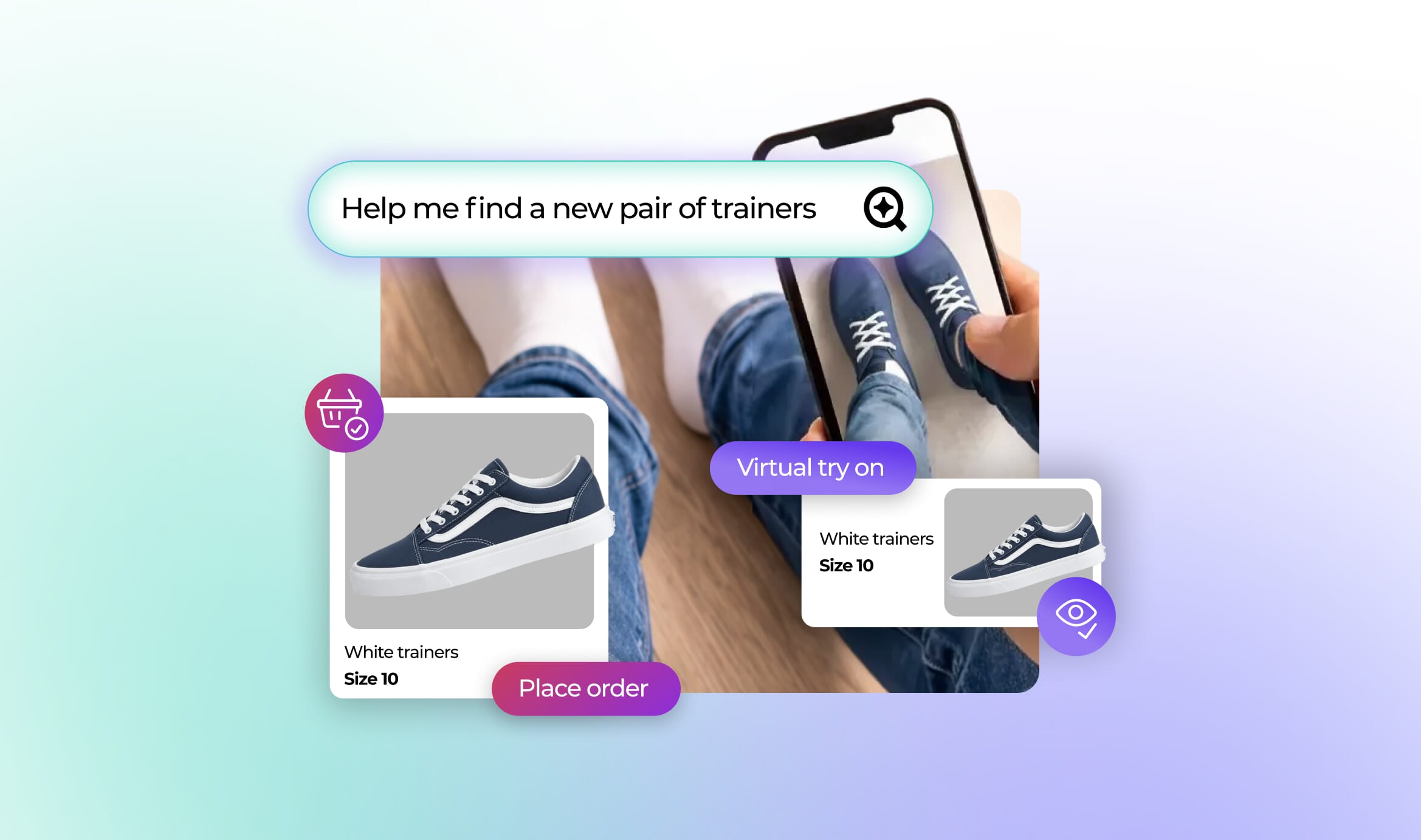
Introduction: when AI stops recommending and starts selling
Agentic commerce, the latest evolution in AI-powered shopping is here. What does it mean, how do brand adapt. Here’s what you need to know.
For years, AI in eCommerce has lived at the edges: chatbots answering FAQs, recommendation engines suggesting products and assistants responding to prompts.
Helpful, perhaps intuitive even, but largely passive.
That’s now changed.
With recent announcements from Shopify and Google, we’re entering the early stages of agentic commerce, where AI doesn’t just assist the buyer in discovery, but can actively carry out tasks on their behalf.
This shift has the potential to remove friction across the entire buying journey: discovery, presenting relevant offers, checking availability, ordering on customers behalf, taking payment and managing post-purchase support, all without the user ever leaving the AI eco-system.
For eCommerce brands, this represents a shift in how and where buying decisions are made, rather than a replacement of ecommerce as we know it.
What is agentic commerce?
A fair question, amongst all the new AI acronyms. Agentic commerce refers to commerce systems where AI agents can autonomously take actions on your behalf, not just provide information in response to a prompt or query.
Instead of: “Here’s a product you might like, click through to buy.”
You can now get: “I’ve found the best option, checked availability, applied a discount offer, placed the order, and confirmed delivery, would you like to proceed?”
From AI assistance to AI execution
Until now, most AI interactions with brands have stopped short of action. An AI driven large language model (LLM) might suggest a product or answer a question, but as the customer, you still needed to visit a website, navigate to a checkout and complete the purchase manually.
Agentic Commerce removes that handoff.
When a customer expresses purchase intent conversationally, inside tools like ChatGPT, Gemini or other AI interfaces, for example the best type of trainer for running a marathon, an AI agent can now act on that intent, surface suitable options and allow for the transaction to be completed. The user remains in the conversation, while the AI interacts with commerce systems in the background.
To make this possible at scale, platforms need two things: consistent, product data that is easily read by AI systems and a way for these AI systems to securely interact with merchant systems and eCommerce platforms.
This is where Shopify’s and Google’s recent announcements become particularly significant.
Shopify’s role: an AI-ready commerce layer
Let’s start at the end, with Shopify, a platform created from the ground up to execute Direct to Consumer transactions.
As well as reporting a record trading period at the end of 2025, Shopify has positioned itself as an execution layer between merchants and AI channels.
At the centre of this is the Shopify Catalog, where product data is standardised, enriched and structured in a way that AI models can reliably understand. Rather than treating product feeds as marketing assets, Shopify is treating them as inputs for autonomous systems.
Once products live within this catalog, Shopify can connect merchants to a growing number of AI-driven touchpoints. These include conversational tools such as ChatGPT, Microsoft Copilot, Perplexity and Google’s own AI experiences, as well as future partners that have yet to be announced.
This means that merchants publish their product data once, and Shopify enables it to be discovered and transacted wherever AI-driven commerce happens.
Alongside this, Shopify has introduced a waitlist for its Agentic Plan, designed for those not using its platform; for example on BigCommerce or Magento, to allow them similar functionality and purchases to happen directly inside AI conversations rather than sending customers back to a traditional storefront.
While it’s still early days, it signals a clear intent: AI is becoming a place where enquiries AND transactions happen, it’s not just another source of traffic.
Ready for growth at scale, see what a new Shopify site can do for your brand
Google’s Universal Commerce Protocol
While Shopify is focused on merchant enablement, Google is addressing a broader compatibility challenge.
Google’s new Universal Commerce Protocol (UCP) is designed to let any AI agent interact with any commerce system, regardless of platform.
Whether a merchant is on Shopify, Magento, WooCommerce, BigCommerce or a custom stack, UCP provides a shared language for AI-driven commerce interactions.
This matters because AI agents are largely platform-agnostic. They don’t care where a product is hosted; they need reliable access to inventory, pricing, offers, order creation and post-purchase information.
UCP is Google’s attempt to ensure that commerce systems can participate in agentic shopping experiences without being locked into a single ecosystem.
This mirrors similar announcements made by OpenAI in late 2025 about its own Agentic Commerce Protocol (ACP). ACP is an open, cross-platform protocol that also enables shopping and payments directly within AI assistants. It’s designed for broad adoption, and like its Google counterpart independent of any single user interface, platform, or distribution surface.
These announcements reflect a broader industry trend towards conversational commerce execution that allows users to complete purchases without leaving the shopping flow.
Agentic shopping inside Google
Alongside UCP, Google has introduced three other major AI shopping features that demonstrate how agentic commerce will appear in practice including; Native Checkout, Business Agent, and Direct Offers.
When users express purchase intent inside Gemini or AI Mode, relevant product offers can surface directly within the conversation. Google also plans to introduce a Business Agent, effectively acting as a brand’s representative inside Google’s AI products.
This agent acts as a virtual assistant, responding to product-related questions in a brand’s tone of voice, check inventory and create orders using information from the business’s website and Google Merchant Center data and provide ongoing support.
Perhaps most notably, Google is enabling AI-native checkout, allowing transactions to be completed inside the AI interface itself.
Two-and a half years after shutting down ‘Buy on Google’ for Search and Shopping to create a new “streamlined buying journey for shoppers” that makes it easier for retailers to sell on Google and YouTube, Google is launching a new AI-led in-platform system.
Finally, Google has announced a new AI Mode ad format named Direct Offers. Google said this is a new “Google Ads pilot that allows advertisers to present exclusive offers for shoppers who are ready to buy”. Think, for example, of a seasonal ‘special 20% off discount’ available directly to shoppers when in AI Mode.
When a query returns certain products, Google Ads can offer the user a promotion and discount to checkout ‘now’. This offers the shopper better value, while also helping the retailer to close the sale.
With Direct Offers, retailers can set up relevant offers they want to feature in their campaign settings and Google will use AI to determine when an offer is relevant to display.
Agentic operations: AI-led business efficiency
Agentic systems will not only transform how customers buy, they will increasingly reshape how businesses operate behind the scenes.
Alongside customer-facing shopping agents, organisations will also deploy AI agents to manage discrete operational functions such as inventory reordering, demand forecasting, pricing adjustments and segmentation optimisation. These agents will operate continuously, monitoring signals across sales, supply, marketing and customer behaviour, then acting within defined guardrails to keep the business running efficiently.
Over time, these agents will become part of a chain of operations, working in coordinated workflows, where the output of one agent becomes the input for another. A demand-sensing agent might trigger inventory replenishment, which in turn informs pricing and promotional logic, feeding directly into marketing and merchandising decisions. Rather than isolated automations, businesses will run agentic systems that execute end-to-end operational flows.
In this model, AI is not simply assisting teams, it is performing specific roles. Humans remain responsible for strategy, oversight and exception handling, while AI agents handle the repetitive, data-heavy and time-sensitive work that once slowed organisations down.
Just as agentic commerce optimises buying decisions for customers, agentic operations will optimise decision-making inside the business resulting in increased speed, reduced waste and enabling teams to focus on higher-value work.
What this means for eCommerce brands
Agentic commerce does not mean ecommerce websites are disappearing. For the foreseeable future, brand-owned sites will remain critical for storytelling, engaging content, building trust and maintaining those essential customer relationships.
Humans are still central to the success of any automated transactions. They still define the parameters, wants, needs and ultimately budget.
But while humans may still make the final decision, what is changing is how customers may arrive at that purchase decision, and where that decision is finalised.
As AI tools become more capable, they will increasingly act as intermediaries between brands and customers.
Brands that can present clean, accurate, structured data-and allow trusted systems to act on their behalf- will be easier for AI to recommend and transact with.
What about agentic commerce fees?
Another fair question. Given the power of these recent partnerships, and the levels of revenue that is already generated by monetised keyword searches, it was always expected that there would be fees payable by merchants using this new functionality.
Google has a long history of paid search revenue, while Shopify will now take a fee for facilitating this execution layer.
Shopify has told merchants that use its commerce software that they will pay OpenAI a 4% fee on sales made through ChatGPT’s checkout feature, on top of the typical transaction fees Shopify charges such as payments processing.
No one likes additional fees but compared to:
- Rising paid media costs
- Increasing CAC
- Attribution blind spots in traditional channels
A predictable execution fee inside high-intent AI conversations may actually be remarkably efficient.
- Read our eBook on the latest eCommerce trends
For more insights into the trends shaping on-line retail in 2026, download our new eBook, ‘from clicks to conversations’.
What merchants should do now
While this technology is still emerging, there are sensible steps eCommerce brands can take now to prepare.
The most important is to treat product data as strategic infrastructure rather than a basic requirement. Clear titles, consistent attributes, structured variants, accurate pricing and availability all become more important when AI systems are interpreting and acting on that data without the safety net of human intervention.
Brands should also keep a close eye on how their commerce platform is engaging with agentic capabilities. For Shopify merchants, this means understanding how product data flows into the Shopify Catalog and monitoring your visibility. For merchants on other platforms, it means following the evolution of Google’s Universal Commerce Protocol and how their chosen platform intends to support it.
Just as importantly, brands should begin thinking about how their brand voice and policies translate into automated environments. If an AI agent is acting as a representative of the business, it needs clear rules around tone, promotions, customer service and escalation. These are operational considerations, not just technical ones.
Finally, it’s worth viewing fees or revenue share models in context. If AI drives traffic with more intent to buy then the percentage Shopify takes for agentic transactions should be compared to traditional customer acquisition costs or costs of sale on other platforms like Amazon or Etsy.
We have already seen better conversion rates for clients from customers driven by AI Search, suggesting that transactions completed inside high-intent AI conversations may prove to be an efficient complement to existing channels rather than a replacement.
A gradual shift, not an overnight change
While the recent evolution of AI search and its integration into the buyer cycle has seen rapid developments, Agentic Commerce is not a switch we expect to get flipped overnight. Standards, governance, trust and measurement will all take time to mature.
In addition, AI driven traffic is still relatively small (0.15% of all internet traffic) compared to traditional search (48.50), but it’s on the rise. And in some cases, it’s sending visitors (68%) who are far more engaged than those coming from Google or Bing.
As time poor consumers look for more ways to make the purchase process quicker, slicker and more aligned to their needs the direction of travel is clear. AI traffic jumped from 0.02% in 2024 to 0.15% in 2025, a rise of 650% or more than seven times. AI is becoming a primary interface for discovery, and commerce is moving closer to the moment intent is expressed. Platforms like Shopify and Google are building the infrastructure to support that shift.
For eCommerce brands, the opportunity now is not to rush, but to prepare, ensuring products, data and operations are ready for a world where buying increasingly happens inside the conversation.
Want to know how your business stands out in AI search, maybe it’s time for an AI audit
If you would like to know how to prepare your business for agentic commerce, contact one of our eCommerce experts today.

Sign up to our newsletter
Keen to learn more about how to grow online?
Get our latest advice articles, masterclass
videos and webinars.
curious for more?